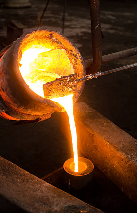
Fire assay is the industry-standard method for measuring gold grade in tailings and ore samples, and every grade figure quoted elsewhere on this site, including the 0.3 to 1.5 g/t range typical of Ghanaian tailings, ultimately traces back to a test like this one. It's preferred for its accuracy and repeatability, and it's the benchmark investors and engineers use to define what a deposit is actually worth.
How does the fire assay process work step by step?
Fire assay starts with a prepared sample, typically a 30-gram or 50-gram charge, which is mixed with a flux and a lead source (usually litharge) and fused at high temperature in a furnace. As the mixture melts, the lead collects the gold and any other precious metals present, sinking to the bottom of the crucible as the lighter slag floats above it. That lead button is poured off, separated from the slag, and taken to cupellation: a second high-temperature step where the lead is oxidized away, leaving behind a small bead of gold (and any silver present). The bead is then weighed directly for a gravimetric result at higher grades, or dissolved and run through an instrument such as an AAS or ICP-MS unit for a more precise finish at the low grades typical of tailings. Each of these stages exists to isolate the gold from everything else in the sample as cleanly as possible, which is exactly why the method has stayed the standard for well over a century.
Why is fire assay preferred over other methods?
Fire assay is preferred over faster alternatives because it measures gold directly rather than inferring it. XRF (X-ray fluorescence) is quick and non-destructive, but it struggles at the low grades typical of tailings and can be thrown off by the sample's mineral matrix, which makes it useful for field screening but not for a bankable grade figure. Aqua regia digestion dissolves a sample chemically and can work well for many metals, but it doesn't always fully liberate gold that's locked inside sulphide minerals, which means it can under-report exactly the gold form that matters most in tailings. Fire assay avoids both problems because the fusion step physically collects all the gold present into the lead button, regardless of what mineral it started out locked inside. That's why it remains the accepted standard for gold-grade reporting, especially when a project's economics depend on precisely measuring a low residual grade.
What sample sizes and standards apply?
Standard fire assay charges are 30 grams or 50 grams, and a properly run program validates its results with certified reference materials (samples of known grade run alongside the real ones), duplicate samples, and blanks (samples with no gold, used to catch contamination). The charge size itself matters more at low grades than it might seem: sampling theory (commonly associated with Pierre Gy's work on particulate sampling) shows that the smaller the charge and the coarser or more unevenly distributed the gold, the larger the sampling error becomes, which is exactly the situation at the sub-1.5 g/t grades typical of tailings. These controls exist because a single assay result on its own tells you nothing about whether the lab and the method are actually performing correctly. For tailings projects specifically, where the residual grade can be marginal, that quality control is what turns a number into a defensible figure rather than a guess.
How does fire assay apply to tailings specifically?
Fire assay on tailings needs careful sample preparation to account for moisture and heterogeneity that a fresh ore sample usually doesn't carry to the same degree. Moisture correction is applied so the grade gets reported on a dry basis, since wet tailings would otherwise understate the true grade of the solid material. Multiple samples across the dump are also needed to capture the variability described on gold tailings composition, because a single sample point can easily misrepresent a dump that formed over years and multiple plant campaigns. That's why a robust sampling program, not a single grab sample, is the first real technical step in evaluating any tailings project.
What happens after assay: how do grades become a resource?
Grades become a resource once enough assay results across a dump are combined with a volume estimate to produce a contained-ounce figure, the number that why old tailings still contain gold works through with a worked example. Formally classifying that figure under a code such as JORC or NI 43-101 is what turns it from an internal estimate into something a qualified or competent person can put their name to and an investor can rely on. That resource figure is what a technical team and an investor actually use to judge a project, not any single assay result in isolation. Getting there also depends on the sampling density being sufficient to represent the whole dump rather than just the points that were tested, which is why assay programs for tailings are typically larger and more systematic than for a comparable ore body of the same size.
What comes after the grade is confirmed
Once fire assay establishes grade, the next step is usually bottle-roll and diagnostic leach testing to determine how much of that grade is actually recoverable, and by which method, the same testwork sequence referenced on the pillar page, gold tailings processing in Ghana.
Why benchmarks depend on assay quality
The realistic recovery rates discussed on whether gold can be recovered from tailings are only meaningful if the underlying grade they're measured against is itself reliable, which is the entire reason assay quality control exists.